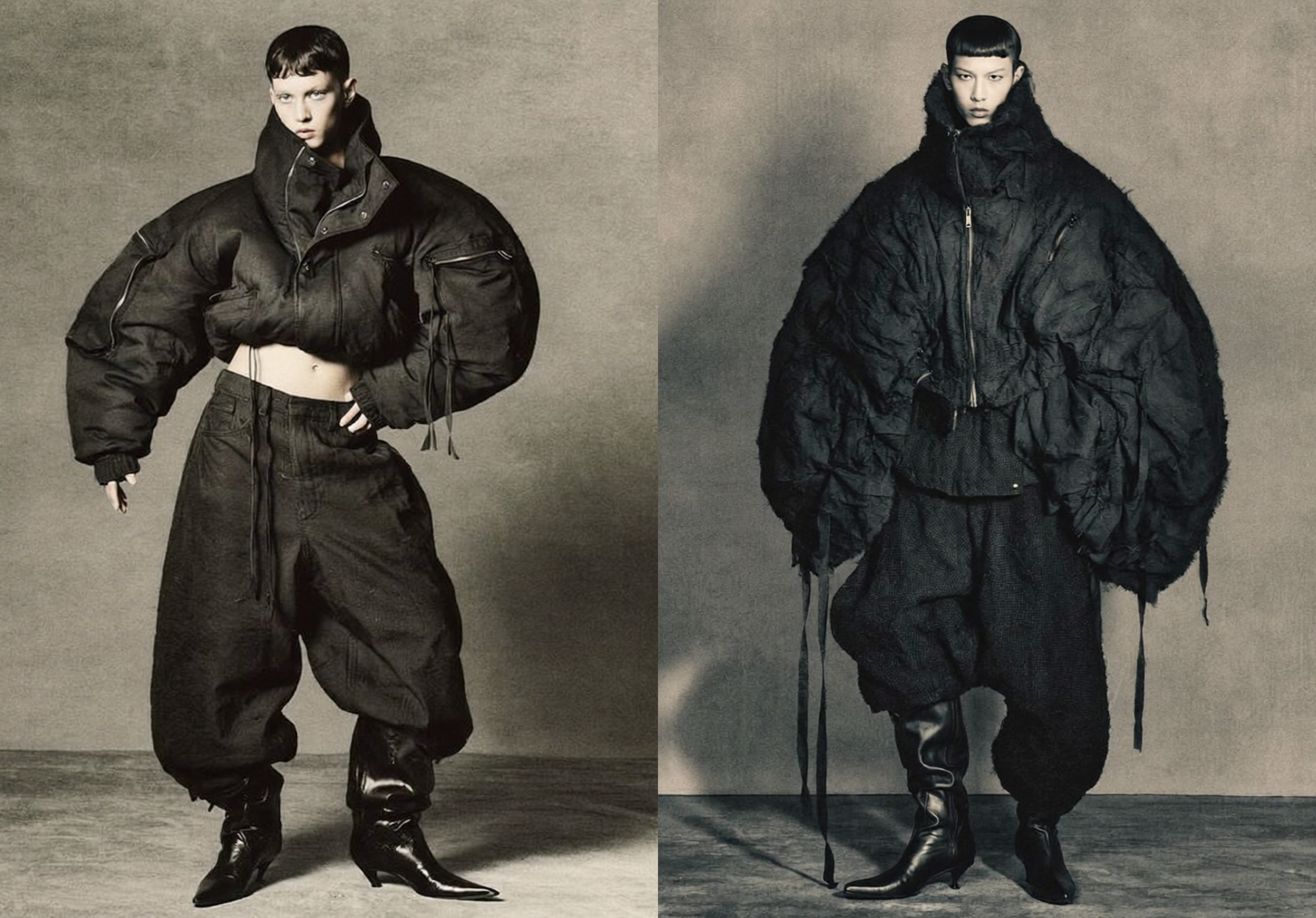
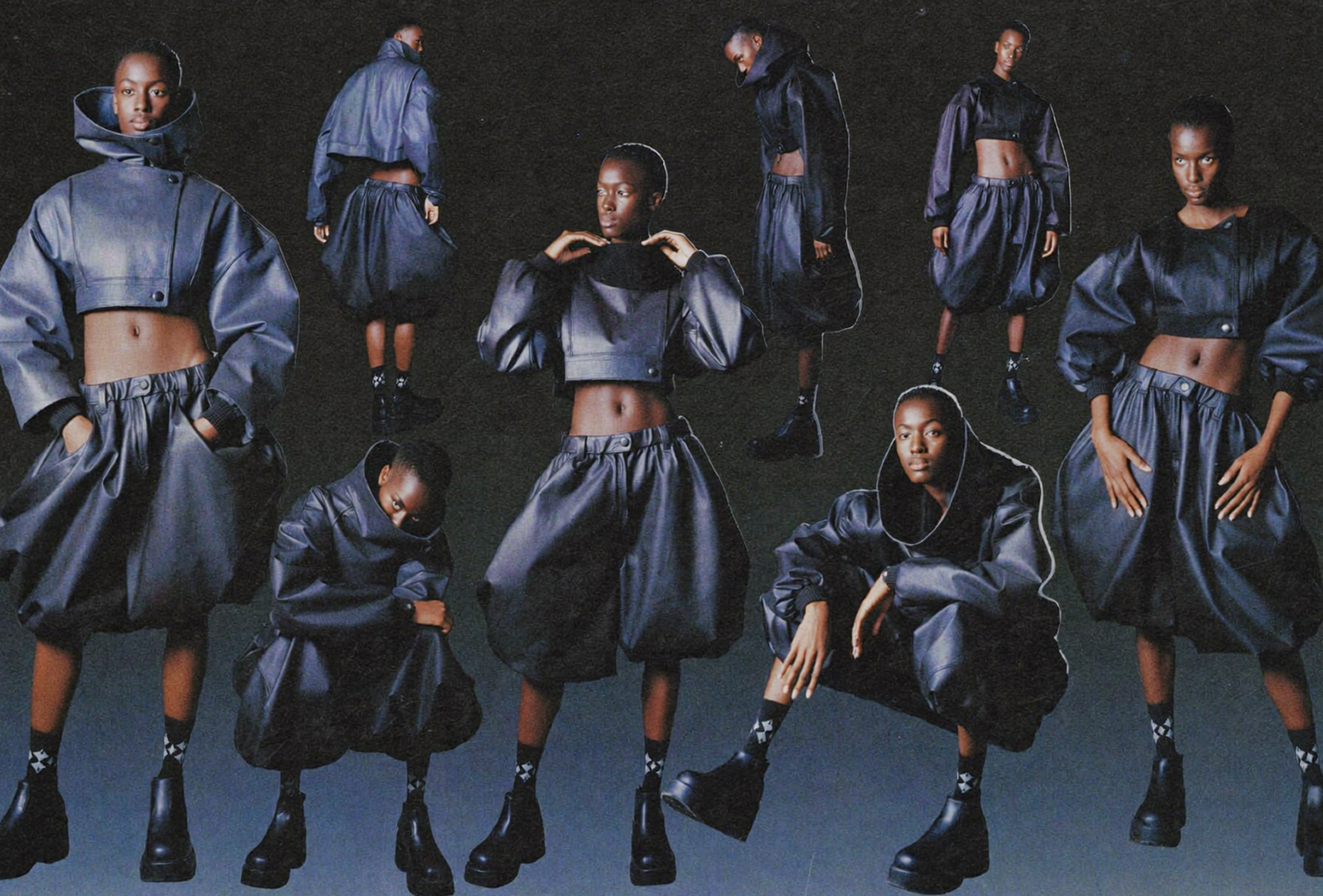
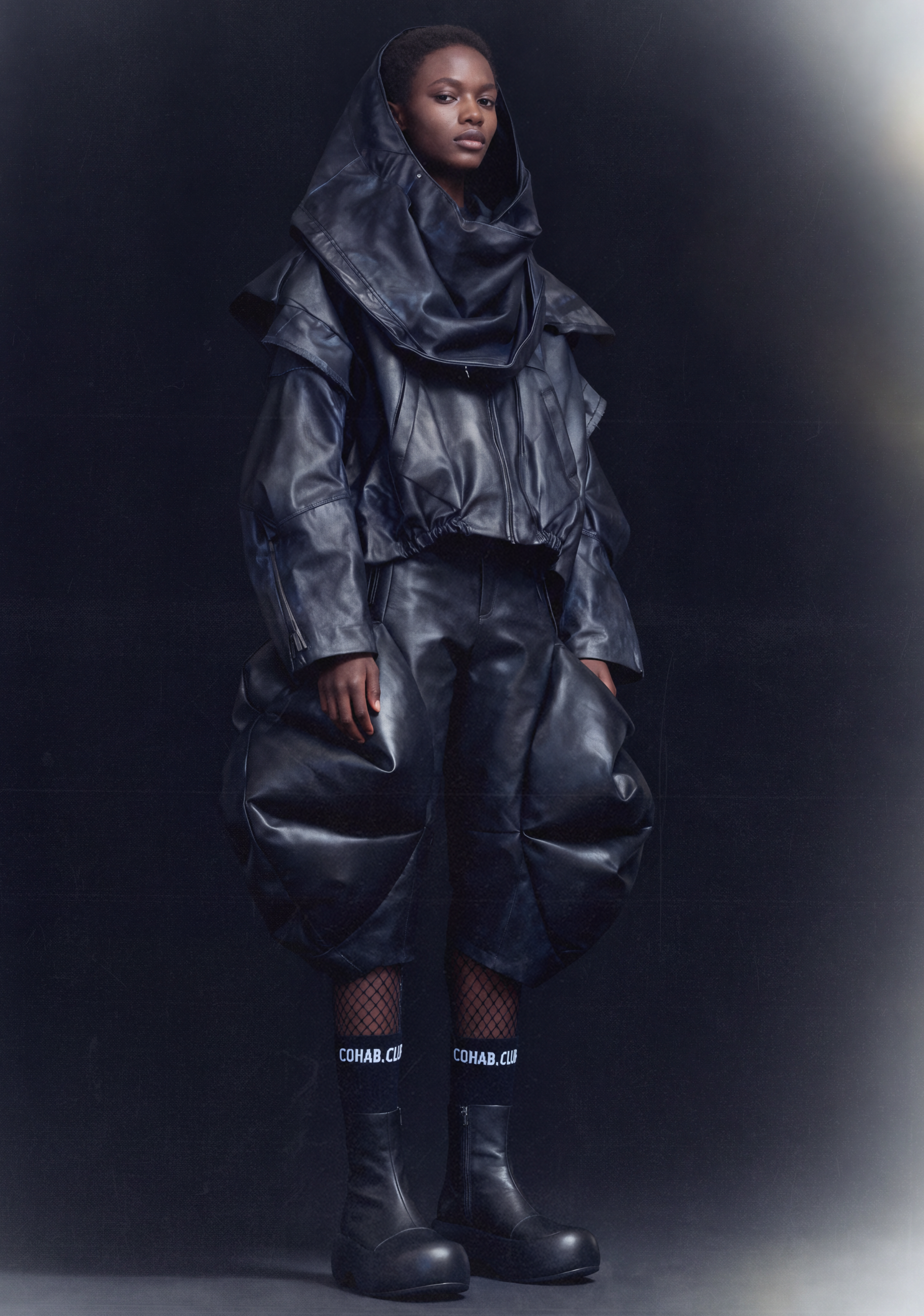
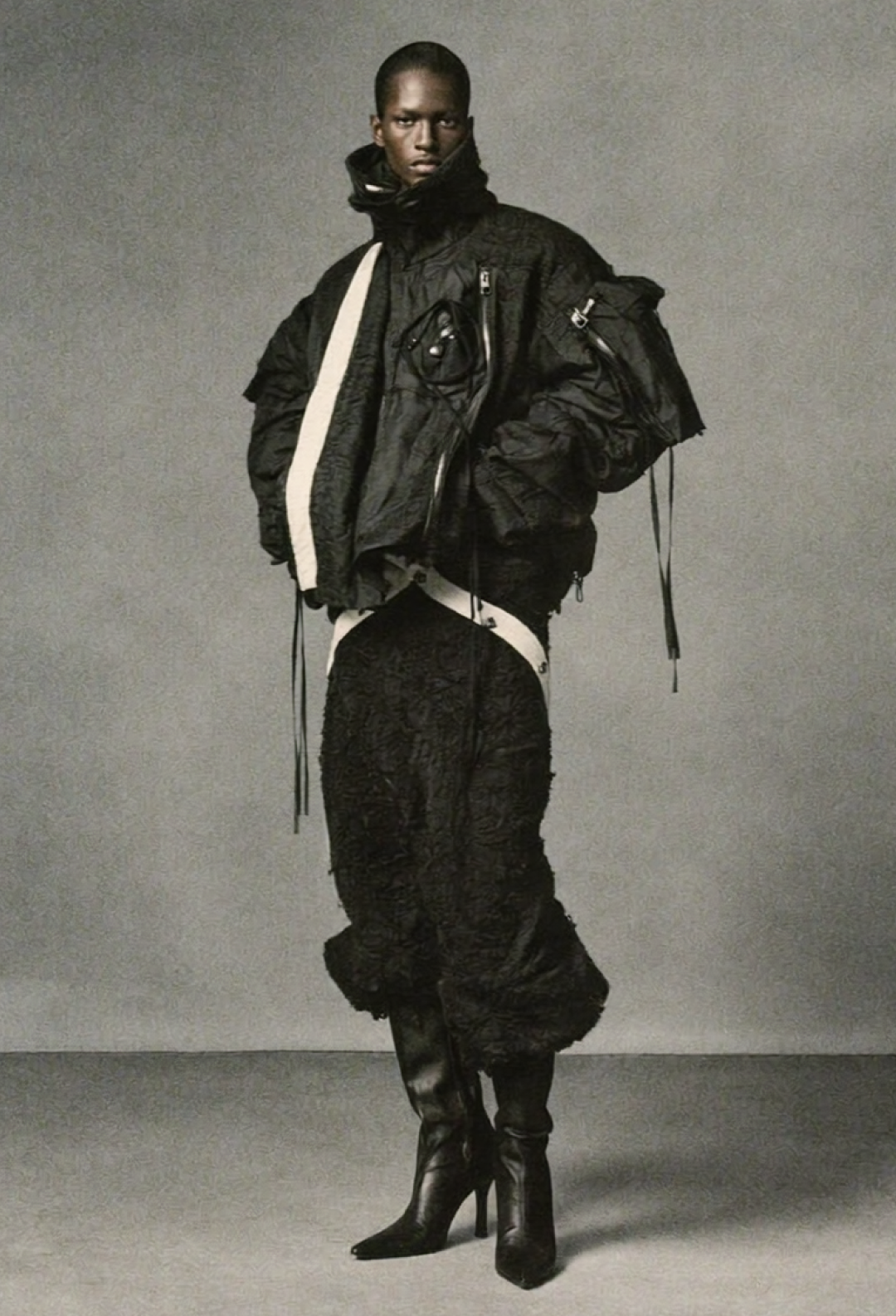
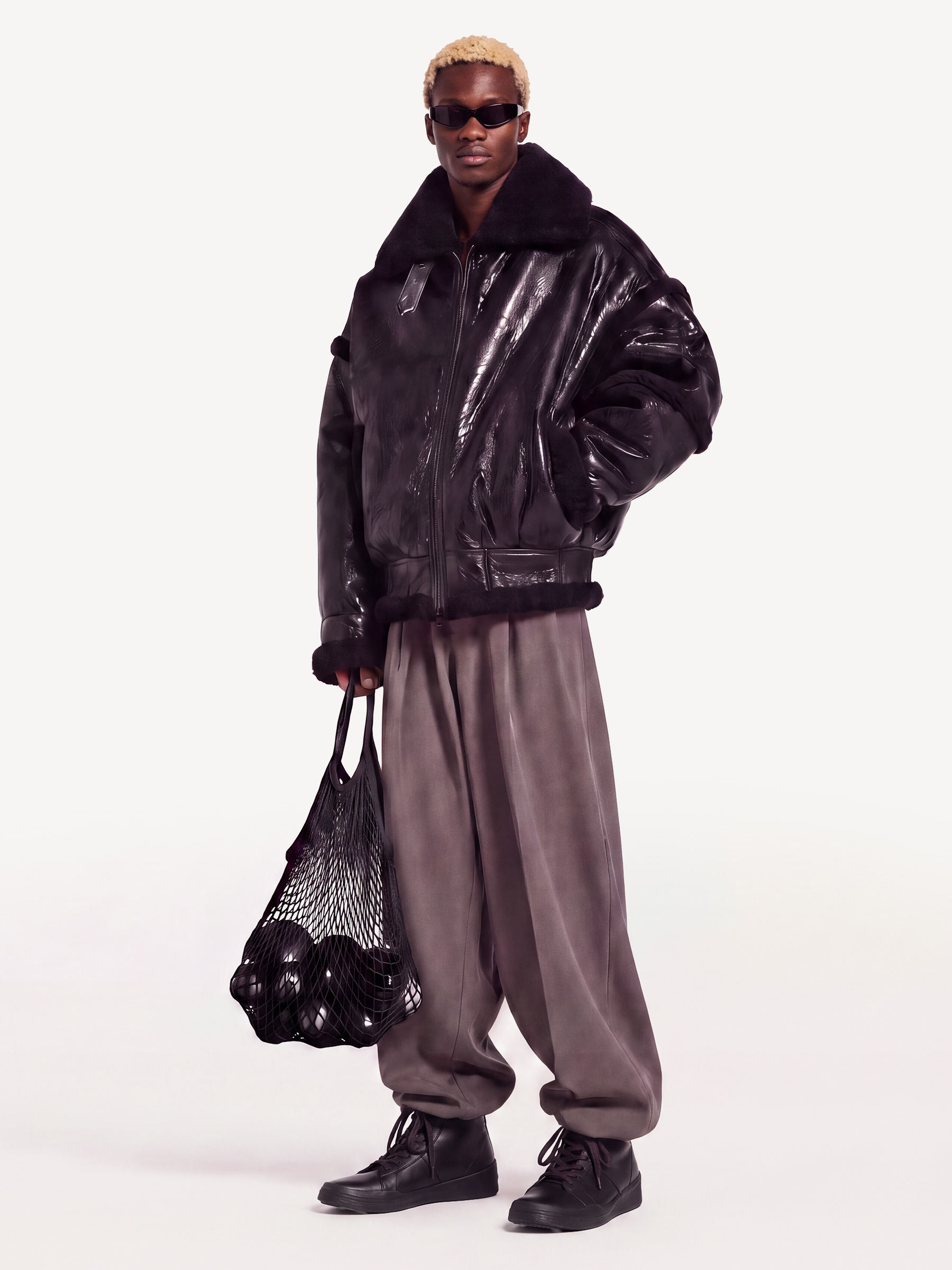
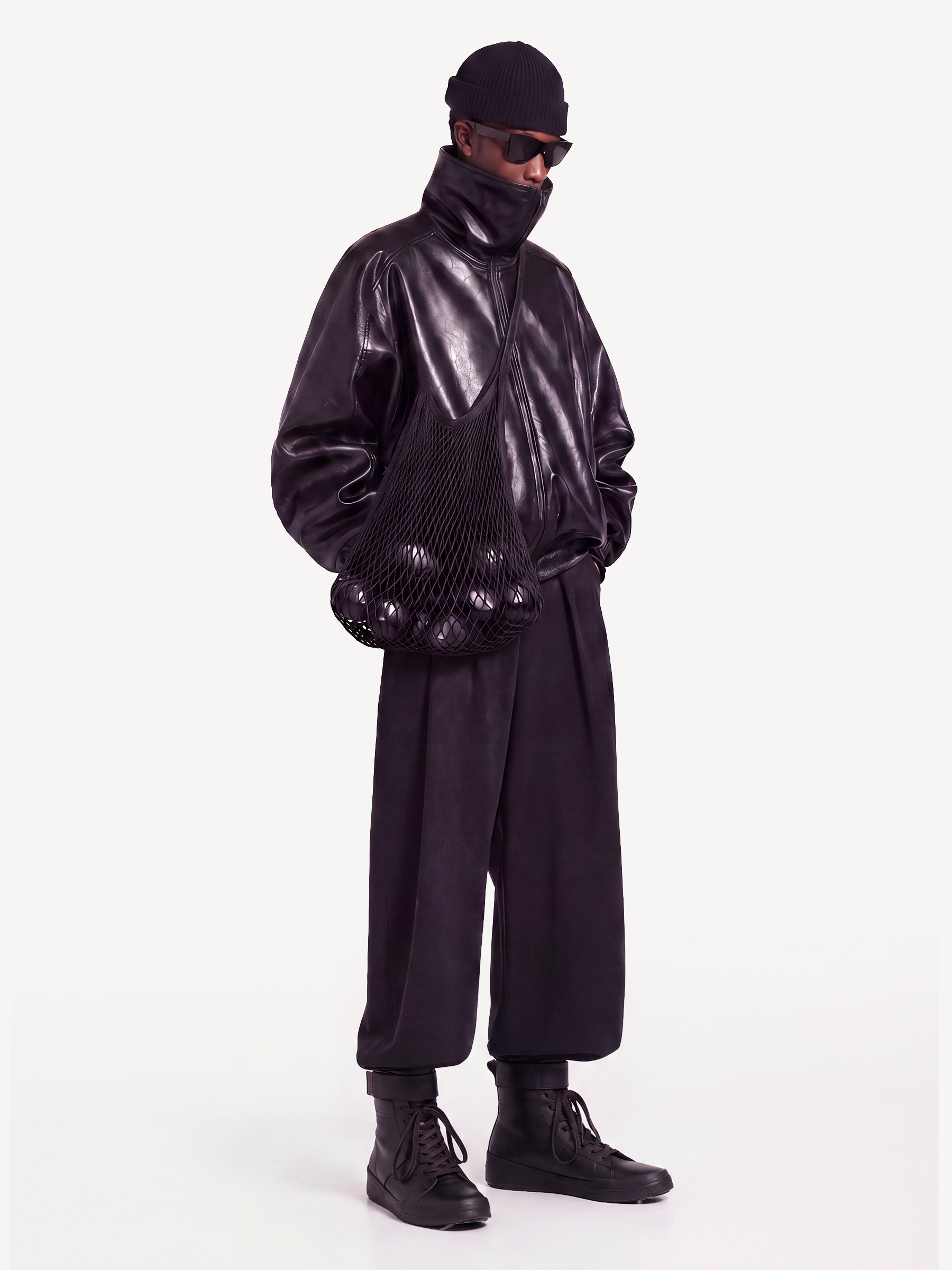
And these days, while wearing something from Periferia System no longer requires knowing where it came from, the reference is still legible in the construction. The line began with what was at hand — offcuts, hardware bought by the kilo, patterns drawn directly onto the table because there was no paper wide enough — and it kept that logic even after the workshop grew and the materials stopped being whatever arrived. Nothing in the first release was designed to look improvised. It was designed the way the outskirts build: with the material already in front of you, and no second attempt budgeted.
When we meet at the studio, the room is smaller than the work coming out of it would suggest. There is a cutting table with a lamp clamped to one corner, two machines, a rail of samples in various states of finish, and a monitor still playing the last edit of the film on a loop nobody has bothered to stop. The founder moves through the space without ceremony, picking pieces up mid-sentence, turning a sole over to show a seam that took four months to resolve, then setting it back down exactly where it was.
The conversation returns often to repetition. A shape is cut, worn for a season, cut again, and only becomes a product once it has survived that loop enough times to stop changing. It is a slow method in an industry built to reward speed, and it goes a long way towards explaining why a studio that has existed for years is only now releasing its first numbered body of work.
CCPS No.1 is an argument for that patience. It moves through the founding materials, the early tests, the shoes that were abandoned halfway and the ones that stayed, without arranging any of it into a story of steady progress. There are images of the studio when it was a single room with one machine, and images from the shoot at the water, where the birds were not directed and the equipment was carried in by hand across a field. It reads less like a lookbook than like a record of decisions, most of them reversible, a few of them not, and none of them arranged after the fact to look like a plan.
At one point in the conversation, asked which piece finally gave the sense of having arrived somewhere, the answer is not a product at all. It is the afternoon the soundtrack and the objects were first put in the same room, played at volume, and the two stopped needing to explain each other to anyone who walked in. Nothing was announced that day and nothing was finished, but the shape of the release was suddenly obvious.
Do you still remember the first moment you knew this would become a practice and not a hobby?
I think it had to do with shoes I could not afford. There were none of the right kind anywhere near where I grew up, so the ones I wanted had to be imagined first and built afterwards, and that order never left me. I started by taking apart what I already owned, which is a destructive way to learn but an extremely fast one. You find out very quickly that a shoe is a small piece of architecture, and that most of what you are paying for is somebody else's decision about where the pressure goes and how long it is expected to last.
If there was a single moment, it was the afternoon I finished a pair that held together through a whole week of walking. Nothing about that pair was good. The stitching was wrong, the shape was heavy, and I would not show it to anyone now. But it was mine from the first cut to the last, and standing there at the end of the week I understood that the distance between wanting an object and making one was not talent. It was time, and time was the one thing I had.
The release captures the improvised feeling of the first years, back when the studio was one room and everything was made by hand. Do you miss working that way?
I miss the speed of it. When nobody is waiting for the thing, you can throw a week of work away on a Friday and start again on Monday morning without explaining yourself to anyone, and you can follow an idea that turns out to be worthless without it costing anybody but you. That freedom is real and I am not going to pretend it was not better in that one specific way.
But I am the kind of maker who needs constraints, and a room with no deadlines in it is not actually free, it is just quiet. What we have now is slower and considerably better. The improvisation is still there. It just happens inside a structure that lets it survive contact with production.
What was the hardest part of getting the first release out?
The hardest part was resisting the pressure to make it legible to everyone at once. There is a version of this line that would have been much easier to sell and would have said absolutely nothing, and I could describe it to you in detail because we built parts of it. Every time we simplified a piece so it would read faster, it lost the exact thing that made it ours, and we would end up returning to the more difficult version three weeks later having wasted the interval.
The other difficulty was practical, and less interesting to talk about but harder to solve. Working from the periphery means your suppliers, your workshop, your references and your people are not in the same place as the industry that eventually turns around and looks at you. We spent a long time proving that this was not a limitation to be apologised for or overcome, but the actual method, the reason the objects come out the way they do. Once that stopped being a defensive argument and became simply how we work, the release assembled itself in a matter of months.
Since then, has there been a single moment where you thought, this is working, this is a practice that can support itself and the people in it?
It has not landed yet, and I am told by people further along than me that this is normal. Interest from makers whose work I respect helps, but it arrives as information rather than as proof of anything.
If I think about it honestly, the closest thing was the first time someone I had never met wore a pair in a city I had never been to and sent a photograph of them worn down. Not new, not styled, not on a white background. Worn to the point where you could see which parts of the construction were holding and which were not. That was more useful than everything else combined, and it is the only kind of validation I have learned to trust.
Looking back, do you have a favorite piece from the release?
Part of why assembling this was such a strange process is that I do not usually feel finished with anything, and putting it together forced me to look at four years of work all at once, in order.
The boot is the one I keep returning to. It was the first shape we drew that did not reference anything else — not a silhouette from somewhere, not a memory of a shoe I wanted as a teenager and could not have. It came out of a problem instead: how to close a high shaft without a zip, using one piece of leather and a single strap. Almost everything the studio has made since has come out of solving that one thing properly, and I can still point at the exact seam where the answer arrived.
You have been working with the same small workshop from the very start. How did that begin?
I met them because a machine broke and nobody else in the city would repair that model any more. I went across town with the part in a plastic bag, expecting to be there ten minutes, and stayed for the whole afternoon watching them work on something else.
I am someone who works from feeling and from drawings, and they work from tolerances and numbers. In the beginning that was pure friction, because I would arrive with a shape that could not physically be built and they would tell me so immediately, without softening it at all. Now it is the reason the objects hold together. They ask what a piece has to survive before they ask what it should look like, and after enough years I have started doing the same thing without noticing.
Any pieces you regret?
There were early pairs where a buyer would ask for a version in a softer material and I would say yes, because saying yes felt like being professional and because the order mattered more than the object that month. Those are the ones that came back damaged, and they came back fast.
I do not regret making them, because they showed me exactly where the line is and I would not have believed it otherwise. But I would never put them in a release. A piece that only works in a photograph is not finished, it is just documented, and there is a difference between those two things that took me an embarrassingly long time to be able to say out loud.
How do you think about the person who wears this, and whether they change over time? Do you see one person, or a set of very different people who happen to agree?
I think of them as a version of the people I grew up around, but with the objects they should have had available to them at the time. People always ask who the reference is, expecting a single name, and there isn't one.
From very early on I knew it would feel strange to see the pieces on somebody with no connection to any of this, and it does. It is also completely fine. The construction carries the origin whether or not the person wearing it knows the first thing about where it came from, and I would much rather the object travel than stay a private argument between me and the workshop. Maybe in five years the person wearing it cares about something else entirely and only keeps the boots because they still work and there is no reason to replace them. That would be the best available outcome, honestly, and it is the one I would choose over any of the others if it were mine to choose.
When we first spoke a couple of years ago the studio had just moved, and you described the period before it as the hardest you had been through. From the outside the work looked steady the whole time. Has the way you handle that changed, or has the difficulty simply moved somewhere else?
I am trying to be less punishing about it. Before, a bad week meant a full rebuild of everything, including the parts that were working perfectly well, and then I would lose a month asking myself why I had done that. Now I can say I did it, it did not work, and next time I will not do it again.
That sounds small written down. It changed how long a project takes here by about a third, because the month of interrogation was never producing anything except a worse mood and a later delivery.
Has building this changed how you look at where you come from?
It brings a lot of it back. Working with material scarcity as a deliberate method makes you notice how much of it you grew up inside without ever having a name for it at the time. You stop reading it as absence and start reading it as a set of solutions somebody arrived at before you did.
Would you ever make something for children?
I think that would be very good, and people ask constantly. I am also realistic about capacity, and I know happens here when we take on more than this studio can actually finish properly.
The soundtrack is unusual for a release like this — not a playlist assembled afterwards to match the images, but something that existed alongside the work the entire time. It sits in the release with the same weight as the objects, which is not how music is usually treated in this context. How did that come about, and was it always going to be part of what people received?
It was never really a decision, which is probably the only reason it worked at all. The room had music in it long before it had any products in it at all, and nobody in the room ever thought to separate the two things or to ask which one was the work.
Did the sound actually change the objects, or is that the kind of thing people say afterwards because it makes a better story than the truth, which is usually that the two were made separately?
Both are true, which is the unsatisfying answer. Nothing was cut to a track, and I would not claim that it was. But the pace of a working day is set by whatever is playing, and pace shows up directly in the decisions — how long you are willing to sit with a problem before you take the fast way out of it.
There is one pair where I can hear it clearly. We were on the same twenty minutes of a record for most of a week, and the closure that came out of that week is the most patient piece of construction in the entire release. That is not mysticism and I am not claiming anything mystical for it. The room was simply calm for five days in a row, and calm rooms produce different objects than anxious ones do. Anyone who has worked with their hands for long enough already knows this and does not need it explained.
You have talked about this as a first movement rather than a debut, which suggests the shape of everything that comes after it is already decided somewhere. How much of that is genuinely written down at this point, and how much of it are you deliberately leaving open?
The structure is decided and the content is not. There will be numbered releases, each one a complete system: objects, images and sound, all issued on the same day. That part is fixed, because it is the only way I know to keep the work honest. You cannot treat the soundtrack as an afterthought if it has to be finished at the same time as the shoes.
What is open is everything else. I genuinely do not know what the second one is about yet, and I am resisting the temptation to decide it early, because the first one only became clear to me about eighteen months in. If I had written the summary at the beginning, I would have spent four years illustrating a sentence instead of finding out what the thing actually was, and you can always tell when someone has done that.
The only rule I have set is that each release has to stand on its own without the previous one. If somebody arrives at No.3 first, it should be complete on its own terms. The numbering is for us, so we know where we are. It is not homework for anybody else, and nobody has to have followed the sequence to understand what they are holding.
I have watched other studios build a narrative first and then spend years servicing it, releasing things they did not believe in because the story required a chapter that season. That is the specific failure I am trying to design around. The structure exists to protect the making, not to generate obligations. If a year goes by and there is nothing worth issuing, then nothing gets issued and the number waits.
Is there a piece from the release that you wear yourself, every day, outside of the studio?
The boot, daily, for two years. It is the only real test I have.
What do you want somebody to notice first when they see the objects in person?
The weight, and then the inside. Most of the decisions that took the longest are not visible from the outside at all — where the lining stops, how the strap is anchored, why the sole is thicker at the back than it strictly needs to be. If someone turns a piece over in their hands and looks at the underside before they ask what it costs, then the work has landed and there is nothing else I need to say. Everything I would explain in an interview is already there for anybody willing to look.
Last one. If somebody comes to this with no context at all, no knowledge of the studio, what should the release tell them?
That it was made somewhere specific, by people who were not waiting for permission, and that the specificity is the entire point rather than a detail in the biography.
Everything in CCPS No.1 could have been made more cheaply and considerably faster somewhere else, and it would have been a different object — not worse in any obvious way, just anonymous. The line exists partly to prove that the alternative is possible at this level of finish. If someone with no context picks it up and simply thinks it is unusually well made and cannot immediately say why, that is more than enough for me. The rest of it is ours to know, and it will still be there in the objects long after this conversation.
CCPS No.1 (1226 C77C) is released as a single movement — the objects, the film and the soundtrack, issued together and numbered. The second is already being cut.